


Production
Built for Scale
Low to high Volume, Quality, Consistency.
Champ3D provides custom 3D printing services for prototypes, functional components, tooling, and production parts. Upload your 3D model, choose a technology and material, get an instant quote, and order your parts online.
From early product development to low-volume production, Champ3D helps engineers, designers, manufacturers, and product teams move from digital design to finished parts. An engineering review follows before production.
Built for Scale
Low to high Volume, Quality, Consistency.
Guided by Experts
DFM Review Design Support Material Guidance.
Self-Serve Quotes
Upload Configure Get Price.

1 Million+
Parts Produced
70,000+
Businesses Served
100+
Unique Materials
31+
3D Printing Technologies
Champ3D is a 3D printing company that takes projects from digital design to finished parts through its online 3D printing service, using six additive manufacturing processes.
SLA, DLP, FDM, SLS, MJF, and SLM, matched to your part's geometry, material, and finish.
Concept models, functional prototypes, tooling, and production parts from one partner.
Resins, thermoplastics, engineering polymers, elastomers, and metals.
Upload your file in minutes, compare options, and review your price.
File review, design optimization, and material selection.
Custom 3D printing services manufacture physical parts from digital 3D models using additive manufacturing. The technology is selected for the part's geometry, material, finish, and intended use. Unlike methods that need dedicated molds or tooling, 3D printing builds parts layer by layer.
It supports concept models, functional prototypes, mechanical components such as brackets, housings, covers, and connectors, jigs and fixtures, custom tooling, replacement parts, and low-volume production.

Step 1
Upload an STL, STEP, or OBJ file. Our quote generator analyzes size, design complexity, volume, and print compatibility.
Step 2
Select the process and material that fit your part's geometry, performance needs, and surface expectations.
Step 3
Check the configuration, quantity, finishing options, and price, then approve your order.
Step 4
Your part is printed, finished, and shipped.
The best process depends on the material, geometry, surface finish, detail, mechanical requirements, quantity, and end use of your part.

Stereolithography cures liquid resin with a laser, layer by layer. It is common for detailed prototypes, visual models, and form-and-fit parts where surface quality matters.

Digital Light Processing cures resin with projected light. It suits small, detailed components, miniatures, and fine features.

Fused Deposition Modeling deposits melted thermoplastic layer by layer. It is common for functional prototypes, concept models, jigs, fixtures, tooling, and larger parts.
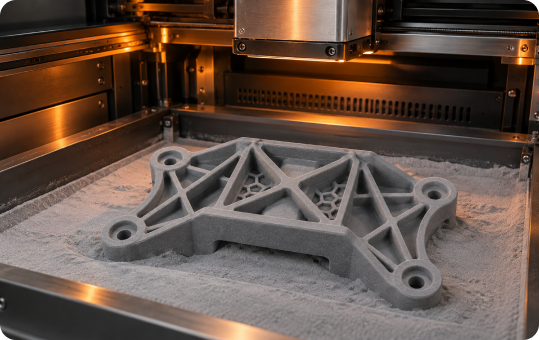
Selective Laser Sintering fuses polymer powder with a laser. The surrounding powder supports the part, so SLS suits functional nylon components and complex geometries.
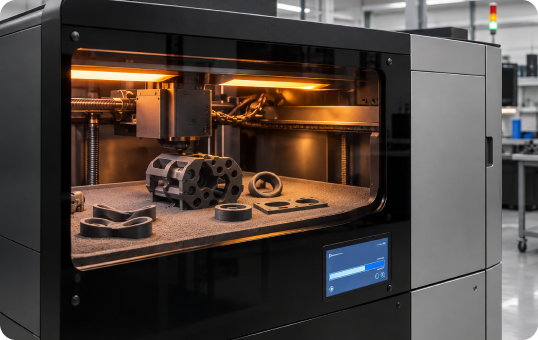
Multi Jet Fusion uses fusing and detailing agents with heat to produce polymer parts. It is commonly considered for functional components, complex nylon parts, and batches.
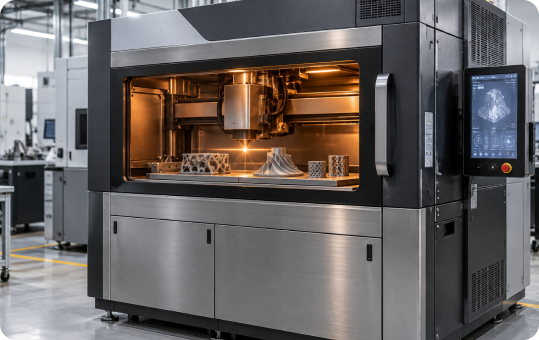
Selective Laser Melting melts metal powder with a laser to build metal components layer by layer, for complex metal prototypes and production parts.
No single technology fits every project. Match the process to what the finished part must do.
Material choice affects strength, flexibility, wear, heat resistance, surface quality, and weight. Choose by the conditions the part will face.

Medium
Low
Low

High
High
Medium

Medium
Medium
High

Very High
Very High
Low
Prototype 3D printing turns a digital design into a physical part you can evaluate before production decisions. It supports concept validation, form and fit checks, assembly evaluation, functional testing, and design iteration. The best process depends on how closely the prototype must match the final part.
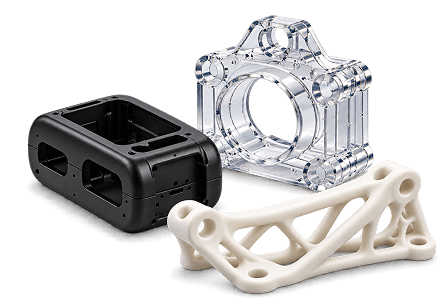
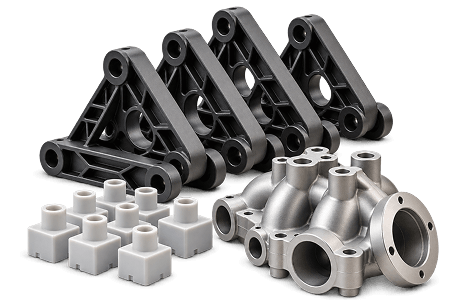
Production 3D printing makes parts for repeated or end-use applications, such as low-volume components, custom parts, replacements, tooling, and complex polymer or metal parts.

Lightweight components, prototypes, design evaluation, and tooling.
Prototypes, fit-check parts, functional components, jigs, and fixtures.
Brackets, housings, mounts, joints, and covers for testing and assembly.
Device prototypes, housings, and models used during product development.
Enclosures, housings, presentation models, and design-validation parts.
Tooling, jigs, fixtures, replacement components, and low-volume parts.
A professional 3D printing service should match the process and material to your part's requirements, not just list printers. Before production, identify geometry, wall thickness, small features, clearances, critical dimensions, build orientation, surface requirements, and inspection needs.
Every order goes through file verification, machine calibration checks, material batch validation, in-process monitoring, and final inspection.
We manufacture parts with defined tolerance ranges based on selected technology and material. Our team reviews file geometry, wall thickness, and feature resolution before production to reduce deviation and maintain dimensional accuracy. This ensures consistent fit, alignment, and mechanical performance across plastic and metal 3D printing projects.
Every order follows a documented QA process that includes:
This layered approach supports stable output quality and production consistency across industrial 3D printing technologies.
Our inspection workflow is designed to validate both form and function:
This systematic inspection workflow strengthens traceability and minimizes production risks.
To enhance performance and appearance, we offer multiple finishing solutions:
Post-processing improves strength, durability,and aesthetic quality for production-ready results.
Post-processing improves appearance, surface condition, or function. Options depend on the technology and material, so confirm them during quoting.

Apply a transparent cosmetic layer to enhance clarity and surface appearance. Ideal for translucent and display-focused parts that require a clean, refined finish.

Parts are sanded and polished before applying high-quality paint finishes. Custom color matching is available for branding or product consistency, including soft-touch coatings.

A cost-effective method for adding color to 3D printed parts. Dyeing provides uniform coloration with faster processing times compared to full paint applications.

Add logos, graphics, or identification markings to improve visual appeal or functional labeling.

Electroless nickel plating enhances durability and provides a metallic surface similar to cast aluminum or magnesium. Suitable for parts that require improved wear resistance.

Achieve a smooth or mirror-like surface for parts that demand premium aesthetics or improved surface texture.

Strengthen and harden metal 3D prints through controlled heat processes, including annealing and hot isostatic pressing (HIP) for improved mechanical properties. Available for metal additive manufacturing parts.

Precision machining enhances surface finish and allows parts to meet tight dimensional tolerances where required. Available for precision-critical components.
Additional post-processing may vary depending on the selected 3D printing technology, material, and production requirements.
Upload your 3D model, compare technologies and materials, and get an instant quote for prototypes, functional components, tooling, or production parts.


